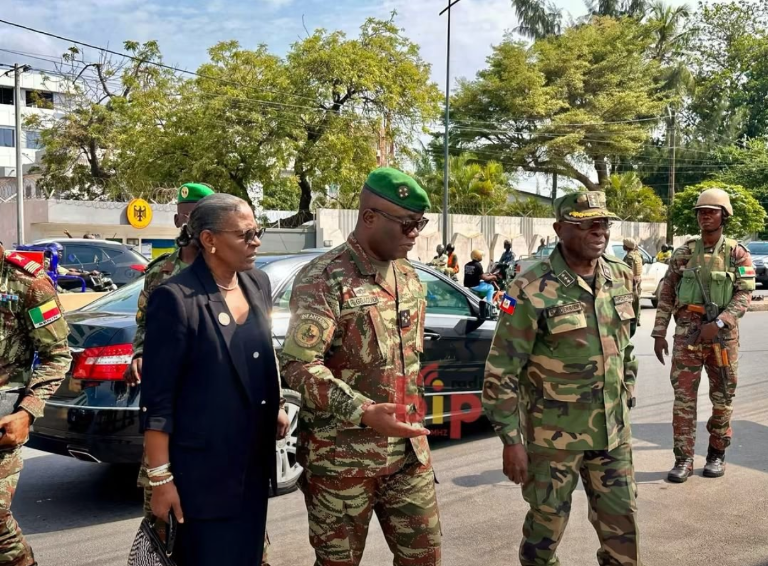
The fallout from Haiti’s deepening security crisis continues to ripple across the Caribbean and West Africa, with Benin now at the center of a renewed debate over regional military cooperation. The two-day visit to Cotonou by Haiti’s top military commander, Lieutenant-General Derby Guerrier, has reignited discussions about potential Beninese support in Port-au-Prince’s struggle against armed gangs and collapsing institutions.
Will Benin finally answer Haiti’s call for security assistance?
Since the Haitian government first floated the idea of international military intervention two years ago, the conversation has been mired in logistical and political complications. At the heart of the matter: Benin’s 2024 pledge to deploy 1,500 troops—a commitment that never materialized due to unresolved questions about command structure, funding, and operational oversight under the UN-backed Kenyan-led mission.
The Beninese delegation’s reception of General Guerrier at the country’s military headquarters signals more than diplomatic protocol—it represents a crossroads for a partnership that could redefine security collaboration between the two nations. But with Haiti’s capital still gripped by gang violence and its government barely functional, the stakes couldn’t be higher.
Lessons from Benin’s own security fight: a model for Haiti?
The West African nation’s experience battling Islamist insurgencies in its northern regions offers a stark parallel to Haiti’s current chaos. Benin’s armed forces have had to rapidly modernize their tactics, intelligence networks, and crisis response systems—expertise that Port-au-Prince desperately needs.
Key areas where knowledge transfer could prove transformative include:
- Counterinsurgency training for Haiti’s depleted security forces
- Civil-military coordination frameworks to restore public trust
- Strategic planning for urban stabilization operations
- Cross-border intelligence sharing to address gang networks
General Fructueux Gbaguidi, Benin’s top military leader, and General Guerrier are expected to explore concrete mechanisms for this exchange during their meetings.
Regional solidarity vs. practical obstacles
The narrative of African solidarity with Haiti isn’t new—historical and cultural ties have long bound the diaspora to the continent. Yet translating this goodwill into boots on the ground has proven far more difficult. Benin’s 2024 offer remains officially on the table, but implementation faces three major hurdles:
- The command structure dispute under Kenya’s police-led mission
- Unresolved funding mechanisms for troop deployment
- Haiti’s deteriorating political situation raising risk assessments
For Beninese officials, the question now goes beyond security assistance to the very nature of international peacekeeping in Haiti—one that aligns with their own military doctrine and operational realities.
The road ahead: dialogue or deployment?
As Haiti’s security vacuum deepens, the pressure mounts on both nations to move from theoretical cooperation to actionable plans. The Cotonou talks will serve as a crucial test of Benin’s willingness to translate its 2024 pledge into reality.
Possible outcomes include:
- A renewed timeline for Beninese troop deployment within the multinational mission
- Establishment of a bilateral training program for Haitian forces
- Creation of joint security task forces for cross-border gang disruption
- Development of a phased security roadmap with measurable benchmarks
While no official decisions are expected immediately, the visit itself marks a pivotal moment in redefining how African nations can collectively address Haiti’s crisis. The real test will come not in the meeting rooms of Cotonou, but in Port-au-Prince’s streets where gangs continue to expand their control.
What Haiti’s security crisis means for West Africa
The situation in Haiti serves as a cautionary tale for West African nations already stretched thin by their own security challenges. The proliferation of armed groups in Port-au-Prince mirrors similar threats in Nigeria’s northwest and Burkina Faso’s Sahel regions.
For Benin, the decision to engage more deeply in Haiti could set a precedent for future security partnerships across the region. Success would validate the South-South cooperation model while failure could reinforce arguments against foreign military interventions in domestic crises.
The coming weeks will reveal whether this latest diplomatic initiative can break the cycle of stalled negotiations and unfulfilled promises that have defined Haiti’s international support efforts since 2024.